How is sexual and reproductive justice key to a sustainable and just development? Inspired by South Africa’s Strategy to the Realisation of Sexual and Reproductive Justice at CPD69
2nd June 2026
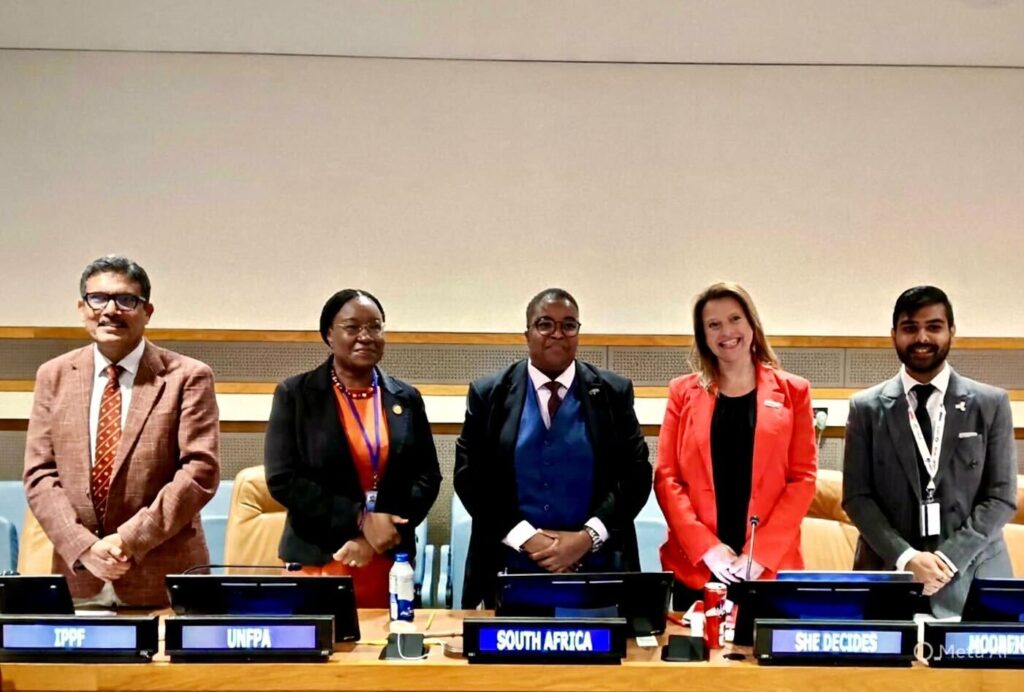
Last month, The Government of South Africa, a SheDecides governmental Champion, hosted a side event at the 59th session of the Commission on Population and Development at UN Headquarters in New York. The event, titled “Roadmap to the Realisation of Sexual and Reproductive Justice: Reframing Population Policy through Evidence, Technology and Community Agency”, featured SheDecides Executive Director Karin Nilsson as a key speaker, and was moderated by Levi Singh from SRHR Africa Trust and part of the South African delegation. We caught up with them to get their read-out.
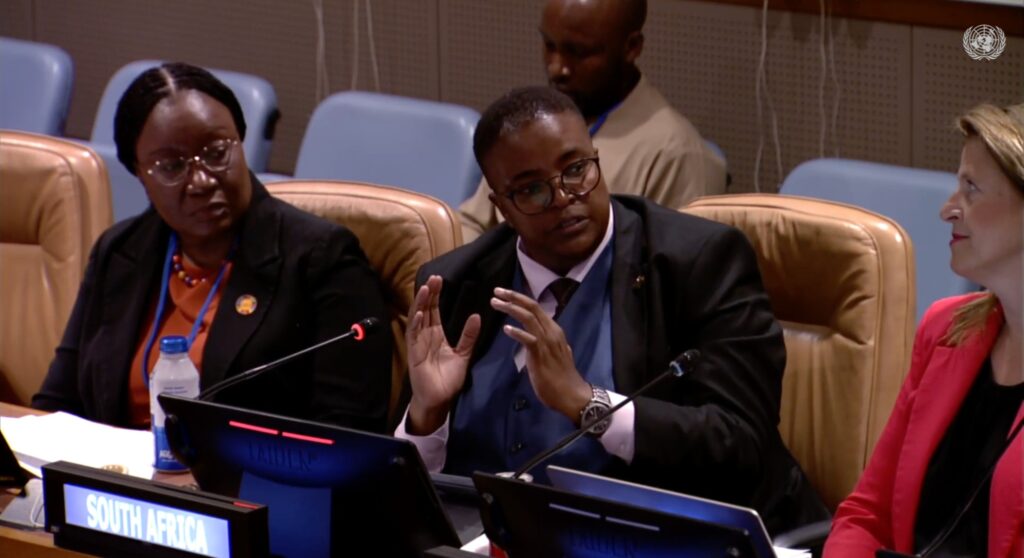
“Sexual and reproductive justice is foundational to development – it is linked to poverty reduction, education attainment, to gender equality, to health outcomes, and to economic participation.” – Deputy Minister “Steve” Mmapaseka Letsike from South Africa’s Presidency for Women, Youth and Persons with Disabilities.
In April 2026, Member States, UN representatives, and civil society practitioners gathered at UN Headquarters in New York for an interactive discussion at the 59th session of the Commission on Population and Development. The event – “Roadmap to the Realisation of Sexual and Reproductive Justice: Reframing Population Policy through Evidence, Technology and Community Agency” – hosted by the Government of South Africa, focussed on their Strategy to the Realisation of Sexual and Reproductive Justice as a development-centred model for advancing equitable population outcomes.
In the context of the 2030 Sustainable Development Goal deadline fast approaching, the importance of learning from countries like South Africa is critical.
The panel brought together Deputy Minister “Steve” Mmapaseka Letsike from Department for Women, Youth and Persons with Disabilities in The Presidency from the Government of South Africa; SheDecides Executive Director Karin Nilsson; UNFPA Regional Director for East and Southern Africa Lydia Zigomo; and IPPF member Dr Noor Mohammed, Executive Director of the Population Services and Training Centre in Bangladesh. The discussion was moderated by Levi Singh of the SRHR Africa Trust and youth representative of South Africa.
Four ways to advance development
The conversation explored how four critical elements, political leadership; evidence-based policy; digital innovation; and community agency can better align to advance SRHR for all. Too often,these operate as parallel streams rather than in connection. Sexual and reproductive justice is not a standalone health issue; it is foundational to sustainable development itself. It is linked to poverty reduction, educational attainment, gender equality, health outcomes and economic participation. Removing structural barriers puts care out of reach for those who need it most. It is what delivering on SDG and CPD commitments actually looks like in practice and leaders must be held to account for achieving them.
In a world where anti-gender and anti-rights movements are deliberately targeting SRHR in a bid to limit the equal participation of women, young people and LGBTQI+ people, a clear political voice for the right to decide is more important than ever.
South Africa’s Intersectional Blueprint
South Africa’s national Strategy for Sexual and Reproductive Justice marks a significant shift in how SRHR is approached at the highest levels of government. Anchored in the Constitution, which Deputy Minister Letsike described as “in itself an intersectional document”, the strategy moves beyond service provision alone towards a comprehensive justice model that addresses structural inequality, intersectionality, governance and accountability.
The strategy recognises that sustainable progress requires multisectoral coordination across health, education, social development and women, youth and Persons with Disabilities, alongside meaningful and structured youth participation. It strengthens governance, monitoring and accountability mechanisms, promotes dedicated resourcing and human capacity development, and prioritises the inclusion of vulnerable and marginalised populations. It integrates mental health, prevention of gender-based violence and crisis preparedness within sexual and reproductive health responses, situating these issues within broader socio-economic realities including inequality, poverty, migration, disability, patriarchy and unequal power relations. “Inequality is never experienced in a single form,” Deputy Minister Letsike said. “Fragmentation weakens impact by producing policies that are technically sound but socially disconnected.”
One size fits all, Deputy Minister Letsike was clear, must give way to responses that are inclusive, responsive and transformative.
Strategies in Motion: Evolving with the Evidence
The results of that response are tangible. A decade ago, South Africa recorded 2,500 new HIV infections among adolescent girls and young women every week. Today that figure is below 700. But as Deputy Minister Letsike put it, “strategies are not stagnant” – they evolve as the evidence and the challenges do. On teenage pregnancy, for example, where over 100,000 births annually remain “unacceptable”, the framing itself has shifted: “These girls are not impregnating themselves”; understanding the social and structural conditions that lead to adolescent pregnancy, she argued, is where the intervention must begin and that work is inherently linked with the HIV response, with violence, and with the broader project of caring for adolescent girls.
SheDecides Executive Director Karin Nilsson reinforced that the political stakes are high. “In a world where we see a lot of fragmentation, we need to stand united,” she said. It is no surprise, she argued, that anti-gender and anti-rights movements are targeting SRHR; it is “an effective way to limit the equal participation in society of women, of young people, of LGBTQI people, of people living in poverty, or other vulnerable or marginalised situations.” “If your own agency and power to decide over your own life is taken away from you, it will be very difficult to have the power to shape and influence your own society and demand change on equal terms.” It is also, she added, about isolating the groups most likely to hold governments to account when they are not delivering on good governance or serving the people they should serve.
The Power of Youth Leadership
One of those groups is young people – and their role in holding power to account, and in shaping the solutions, was a thread that ran through the entire discussion.
Moderator Levi Singh, a South African youth representative from SRHR Africa Trust and part of the South African delegation, framed it simply: young people are designing the world they will ultimately inherit. UNFPA’s Lydia Zigomo was hopeful, noting that young people are already leading on innovation, digital transformation and AI. We need to stop seeing young people as beneficiaries and instead recognise them as participants, actors and agents of change in their own right. “Sometimes if you can’t beat them and you can’t join them at the table they’re at,” she said, “why don’t we create our own tables?” And that is exactly what young people are doing. Deputy Minister Letsike offered a quieter image for youth’s future: “the roots are good but make sure they can nurture the tree.”
Global Evidence: Putting Community First
The discussion was further grounded in real-world evidence. UNFPA’s Lydia Zigomo pointed to Ethiopia as a powerful example of what political commitment looks like in practice: the Health Extension Workers Programme has placed frontline health workers directly in communities, speaking to women and girls where they are. The result is dramatic with maternal mortality falling from 676 to 366 deaths per 100,000 – proof that nationally determined, community-rooted approaches deliver.
Dr Noor Mohammed of IPPF member association the Population Services and Training Centre in Bangladesh offered a principle that underpins all of it: before writing a single policy, they went to the community first, then to the district level, then to the national level. “Every community is different, even in a single country,” he said. Involve people in every stage of intervention: planning, implementation, evaluation, and the results follow.
From the floor, the Ghanaian delegation iterated their support for SRHR noting that Ghana’s approach is anchored in a rights-based framework spanning its Constitution, a revised National Health Policy, a dedicated Adolescent Health and Development Programme, and a Digital Health Strategy running through to 2027.
The Path to 2030
The message from the room was clear: the solutions exist. They are being built in South Africa, in Ethiopia, in Rwanda, in Bangladesh, in Ghana, by governments, communities, frontline workers, and young people who are leading the way. As Lydia Zigomo put it, “African solutions for African problems”. The knowledge, the evidence and the political frameworks are there. What is needed now is the will to connect them – political leadership, evidence-based policy, digital innovation and community agency – not as parallel streams, but as one. With 2030 approaching, the cost of fragmentation is too high. The time to act is now.