

Spain’s Feminist Foreign Policy Leadership Puts Bodily Autonomy at the Centre
1st July 2026
As anti-rights movements become increasingly coordinated across borders and attacks on gender equality intensify, one message emerged clearly from the Fifth Ministerial Conference on Feminist Foreign Policy in Madrid: sexual and reproductive health and rights (SRHR) are not a side issue. They are central to democracy, human rights and feminist foreign policy itself.
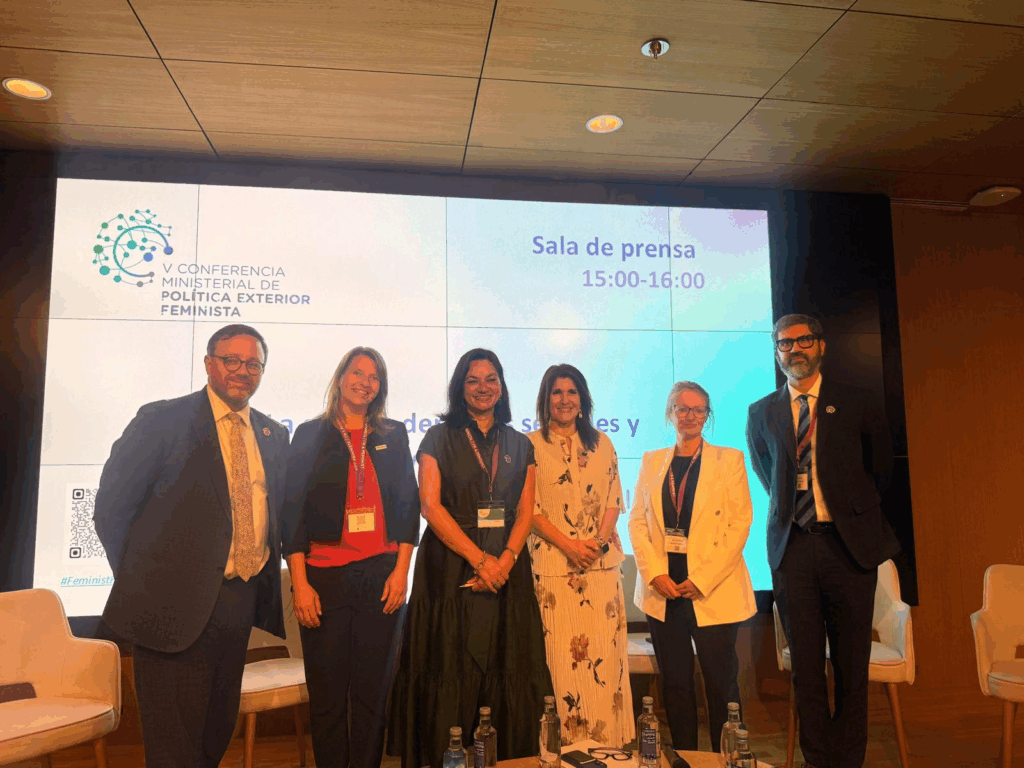
Hosted by Spain, the conference brought together governments, civil society and multilateral organisations committed to advancing gender equality at a time of growing political uncertainty. The meeting culminated in a Political Declaration reaffirming the importance of feminist foreign policy as a tool to advance democracy, peace and human rights and strengthening cooperation among countries committed to these goals.
SRHR: The Non-Negotiable of Democracy
For SheDecides, the conference represented an important opportunity to keep bodily autonomy firmly on the agenda.
Together with the Spanish Agency for International Development Cooperation (AECID), SheDecides co-organised one of two sessions dedicated to exploring why sexual and reproductive health and rights are a fundamental pillar of feminist foreign policy.
The discussion, moderated by SheDecides Executive Director Karin Nilsson, brought together leaders from governments, international organisations and civil society who shared a common concern: the backlash against SRHR is not happening in isolation. It is part of a broader effort to weaken democratic institutions, undermine multilateralism and roll back hard-won human rights protection.
Opening the discussion, AECID Director Antón Leis García delivered a message that resonated throughout the session: sexual and reproductive rights are not negotiable. As he noted, these rights are an integral part of human rights and core to feminist foreign policy. In a world where progress towards gender equality exists alongside increasingly organised opposition, he argued that the answer must be more democracy, more multilateralism and more feminism.
This framing set the tone for a conversation that consistently linked bodily autonomy to the health of democratic societies.
Global Voices, Local Impact
Representing the United Kingdom, Chris Elmore, Parliamentary Under-Secretary of State, Foreign, Commonwealth and Development Office, emphasised the importance of strengthening local leadership and ensuring that communities themselves have the power to shape their futures. He highlighted the need to protect fundamental rights through international cooperation and strong multilateral partnerships, particularly across regions such as Latin America and the Caribbean. At a time when civic space is shrinking in many contexts, his intervention underscored the importance of investing in local actors and feminist movements as essential defenders of democracy and human rights.
Jennifer Feller, representing Mexico’s Ministry of Foreign Affairs, offered a powerful reminder that bodily autonomy is fundamentally political. She argued that sexual and reproductive health and rights cannot be separated from broader questions of social justice, equality and democratic participation. If feminist foreign policy is to be coherent, she noted, it must place bodily autonomy at its centre. Her intervention also highlighted the importance of South-South cooperation and the need for governments to work collectively to protect rights in multilateral spaces.
Reaching the Most Marginalised
A recurring theme throughout the discussion was the need to ensure that progress reaches those who continue to be left behind.
Paula Narváez, Regional Director UNFPA Latin America and the Caribbean, reminded participants that while important advances have been achieved globally in education, reproductive rights and women’s political participation, these gains remain deeply unequal. Rural women, Indigenous communities, adolescents and people facing multiple forms of discrimination continue to experience significant barriers to healthcare and rights. Under the principle of leaving no one behind, she stressed the urgent need to reduce maternal mortality and guarantee access to comprehensive sexual and reproductive health services, including safe abortion.
Funding the Frontlines & Building Alliances
The conversation also focused on what Leah Hoctor, Vice President Europe, Center For Reproductive Rights, considered a key element: to relentlessly pursue progress, not stay still, move forward. For that to happen the discussion also dealt with what is required to turn political commitments into meaningful change.
The importance of sustainable financing for SRHR was repeatedly raised, particularly at a moment when development assistance is under pressure. So too was the call for predictable and long-term investments that reach frontline organisations, especially local feminist groups and women-led organisations. There was broad agreement that defending rights requires not only political leadership but also the resources necessary to sustain movements, protect human rights defenders and ensure access to services.
Another strong message was the importance of coalition-building, as Rajat Koshla, Executive Director, PMNCH underscored. Across the discussion, speakers emphasised that governments cannot defend SRHR alone. Progress depends on alliances between states, civil society, multilateral institutions, parliamentarians, healthcare providers and feminist movements. Building and strengthening these coalitions will be essential to counter increasingly coordinated anti-rights actors.
Spain’s SRHR Leadership
This is where Spain’s leadership stands out.
At a time when many governments are stepping back from global leadership on gender equality, Spain has chosen to step forward. Through its feminist foreign policy agenda, its support for multilateral cooperation and its willingness to create political space for difficult but necessary conversations about bodily autonomy, Spain is helping to build a coalition capable of defending rights in an increasingly challenging global context. Spain is also one of the few Governments who are increasing their contributions to ODA – at a time when many other states are cutting down.
Beyond Declarations: The Road to 2030
The Political Declaration adopted in Madrid sends an important signal about holding the line. It showcased that partnerships matter — between governments, civil society, multilateral institutions and feminist movements. At a time when SRHR is increasingly contested and funding is under pressure, these partnerships are essential to protecting services, advancing rights and ensuring that women, girls and young people in all their diversity, have the means and power to make decisions over their own bodies, lives, and futures.
But the conference also made clear that declarations alone are not enough. The next challenge is implementation: translating commitments into foreign policy priorities, diplomatic action, sustained financing and stronger partnerships with feminist movements around the world.
For SheDecides, the path forward is clear. Progress depends precisely on our ability to strengthen the links between rights, representation and resources — and to build the partnerships necessary to sustain them. Defending bodily autonomy must remain at the heart of efforts to strengthen democracy, advance gender equality and uphold human rights. As the discussions in Madrid demonstrated, sexual and reproductive health and rights are not only essential for individual freedom and dignity; they are fundamental to the inclusive, democratic and peaceful societies that feminist foreign policy seeks to build and will be key as we move towards 2030 and the development cooperation agenda beyond.